


Community Clothing: A Business Model Built Around UK Manufacturing
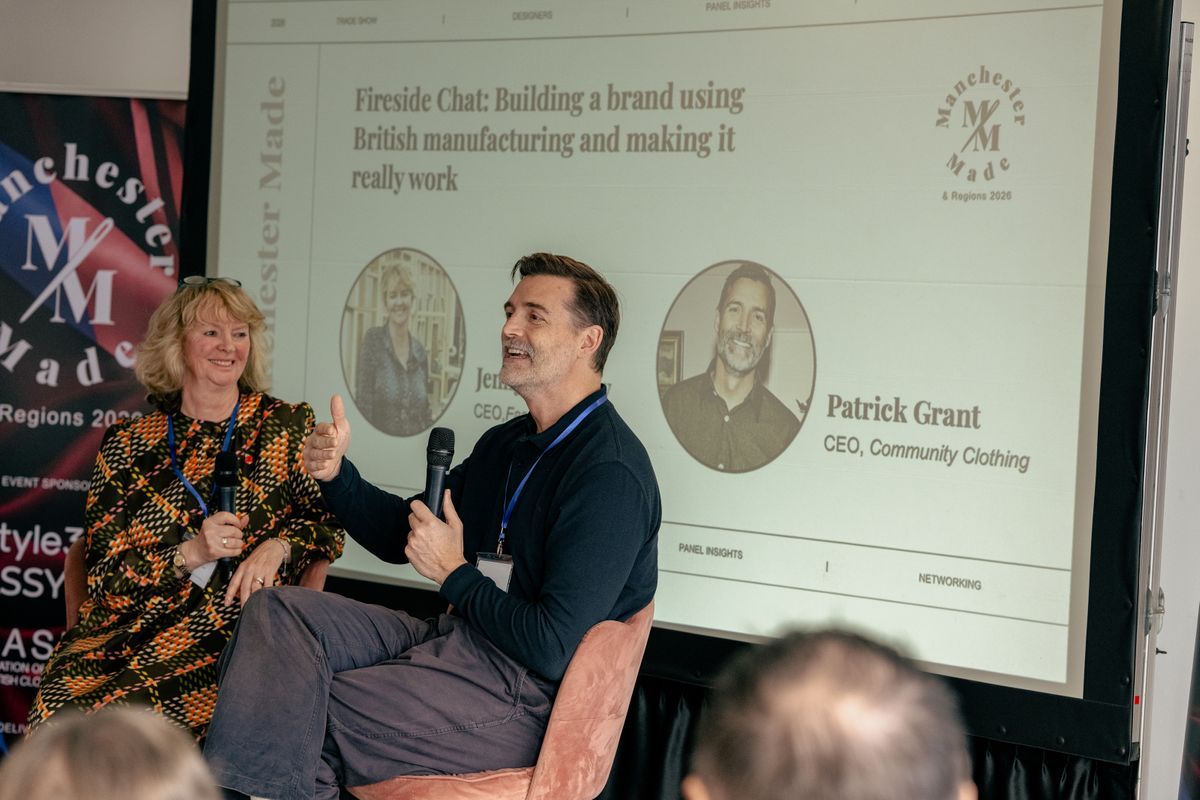
What does it take to make British-made clothing more accessible? Patrick Grant shares how Community Clothing supports UK factories with quality everyday pieces and steady, year-round production.
Can clothes made in Britain be good quality, fairly priced and made in a way that supports local jobs? At Manchester Made & Regions on 4 November, Patrick Grant explored that question in conversation with Jenny Holloway, CEO of FashionCapital and Founder Chair of Fashion-Enter.
Grant, a tailor and founder of Community Clothing, started the business to address two connected challenges: the loss of work in the UK’s textile and garment industries, and the lack of affordable clothing that he considers genuinely well made.
Keeping factories working year-round
Community Clothing now works with 59 partner factories across the UK, including in the East Midlands, Lancashire and Greater Manchester, Yorkshire, and the Scottish Borders.
Grant said the business grew from seeing what happens when factories face irregular orders, stop-start production and uncertain demand. Community Clothing’s answer is to focus on everyday staples that remain in its range year-round. The aim is to give factories more predictable work and allow orders to be planned further in advance.
The approach also shapes the products themselves. Rather than continually replacing its range with new seasonal designs, the business focuses on pieces it expects to keep selling for many years. That continuity helps suppliers plan production and lets the company build long-term relationships with specialist makers.
 Making British-made clothing more accessible
Grant described price as a central part of the model. British-made clothing often sits at a premium price point, putting it beyond the reach of many shoppers. Community Clothing aims to offer well-made products at prices more people can afford.
To support that, the business has made different choices from a traditional retailer. It sells through its own website, keeping control of its sales channel, and has reduced costs such as physical retail overheads and large marketing campaigns.
The company also puts its supply-chain story in front of customers: where a garment is made, who made it and how the economics work. Grant said that this transparency helps customers understand what they are buying and why it costs what it does.
Letting the product and its story do the work
That connection can also help UK manufacturers find new customers. Grant cited collaborations and retail projects as ways to introduce the business to wider audiences, while keeping its own product and manufacturing story at the center.
The model still depends on building enough demand to keep production lines running efficiently. Grant argued that greater, more consistent volumes could help UK factories improve efficiency and reduce costs over time.
Community Clothing’s approach offers one example of how a clothing brand can link product decisions, pricing and storytelling to the health of its supply chain. Its central idea is straightforward: make useful clothes people can afford, and build the steady demand that helps the people making them keep working.