
能否将利润与销量脱钩?
)
欢迎来到《Source Illustrated》——这是一个源自2025年7月Source Fashion活动期间“Source Debates”论坛现场的活力与灵感而打造的博客系列。我们与朱莉娅·巴卡伊(Julia Bakay)合作,她将现场的活力与灵感凝练成一幅极具表现力的信息图。每周,我们将围绕这幅作品的主题展开探讨,深入剖析业界若干最紧迫问题的核心思想。
点击此处注册,在下一场演出中现场观看辩论
For years, the fashion industry has treated growth as a simple equation: make more, sell more, earn more. But as sustainability becomes a non-negotiable, that formula starts to look painfully outdated. If the future of fashion is supposed to be greener, then producing endless volumes of clothes, even “sustainable” ones, won’t get us there. The industry is beginning to ask a bigger question: what if success didn’t rely on selling more stuff?
It sounds radical. Maybe a little uncomfortable. But it’s can also be realistic.
Growth and profit don’t always align
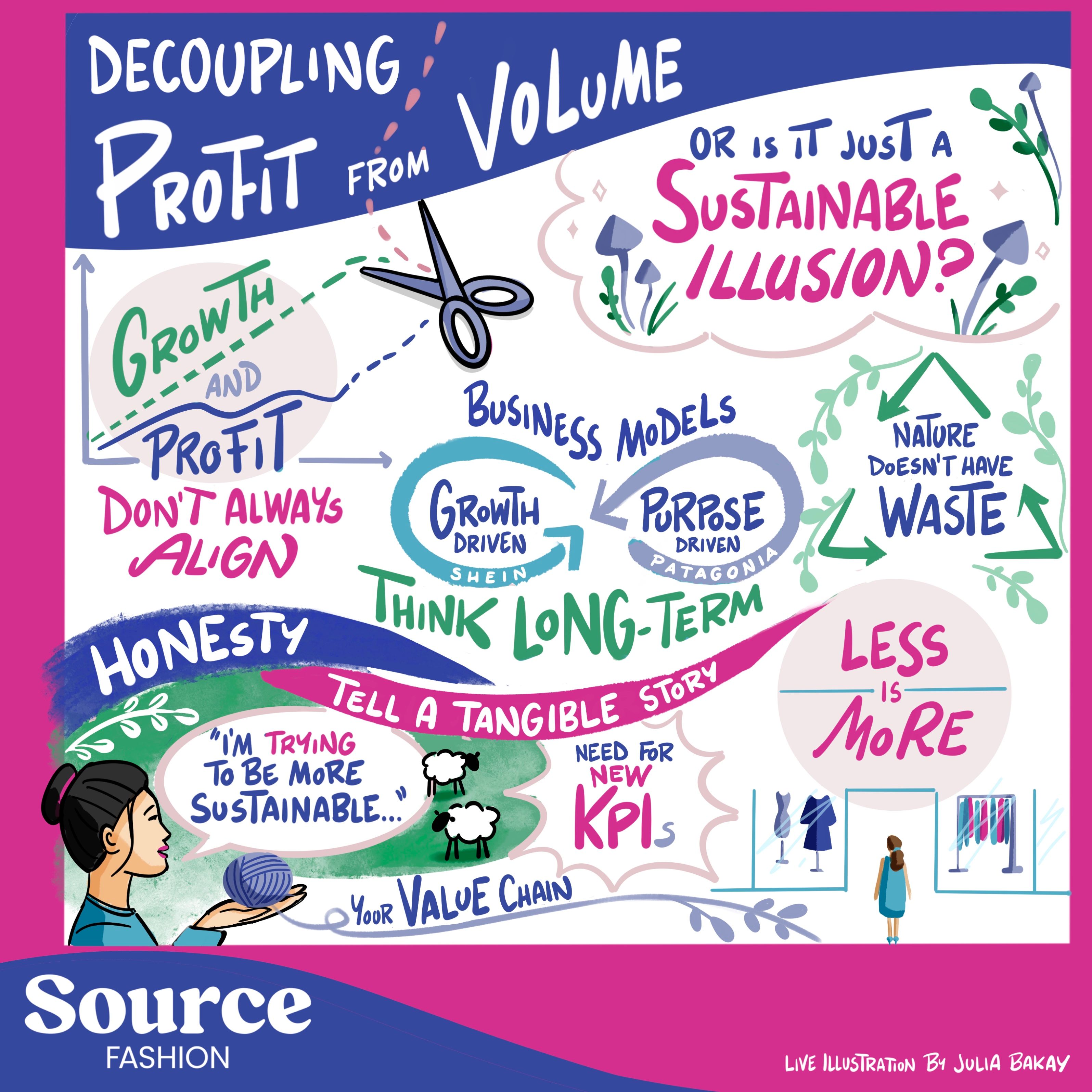
The infographic’s scissors cutting profit away from volume say it plainly: the most sustainable business models of the future won’t depend on scale alone. Right now, fast fashion companies can see profits soar by pushing product into the market at breathtaking speed and volume. But long-term? That’s a fragile strategy both financially and environmentally.
If we take sustainability seriously, the goal becomes producing smarter, not endlessly. Less volume, more value.
Different models, different mindsets
There’s a stark contrast in the industry. On one side, you have growth-driven giants who scale with speed. On the other, purpose-driven models like Patagonia, who back up their values with repair programmes, resale platforms, lifetime guarantees and a willingness to publicly encourage customers to buy less.
Both generate revenue. But they do it differently.
The big shift coming is that sustainability goals and profit goals won’t be able to live in different rooms anymore. New KPIs are emerging - measuring carbon, circularity, repair rates, resale value, and material impact. We’re heading toward a world where sustainability isn’t a side metric. Finally!
Nature doesn’t have waste - so why do we?
Circular design thinking is at the core of this. Nature operates in loops. Everything feeds into something else. Fashion has historically done the opposite: make, sell, discard.
If brands rethink waste as a resource rather than an inevitability, new systems emerge:
-
take-back schemes
-
rental
-
refurbishment
-
resale
-
small-batch or made-to-order production
It’s not just a sustainability exercise, it can be a profit model too. A garment that’s repaired, resold and reused generates value multiple times, without additional resource extraction. “Less is more” becomes a business case, not a slogan.
Honesty isn’t a marketing exercise
Another major theme: transparency. “I’m trying to be more sustainable…” isn’t enough anymore. Consumers want receipts. Certifications. Traceability. Proof.
That’s where storytelling matters - not as a glossy campaign, but as tangible, trackable changes across the value chain. If you’ve switched to regenerative cotton, talk about the farmers. If you’ve redesigned packaging, share the numbers. Sustainability can’t be vague. It needs evidence, and brands who communicate clearly will earn trust—and loyalty.
And yes, some of it might be smoke and mirrors
There’s also a hard truth: not every “sustainable” product or collection is what it claims. Greenwashing hasn’t gone anywhere. Brands are increasingly being challenged to show that their good intentions hold up under scrutiny. The difference between real impact and a marketing message is tightening.
As legislation strengthens around green claims, the industry will be forced to clean up its language—or justify its actions.
The value reset
Ultimately, decoupling profit from volume forces a redefinition of value:
-
Value in durability
-
Value in repair
-
Value in emotional connection to a garment
-
Value in circularity
-
Value in accountability
The fashion industry was built on constant replacement. A sustainable future will be built on longevity.
The question isn’t whether fashion can be profitable without churning out endless newness. The question is which brands will be bold enough to prove it.
And if they do, maybe “less is more” won’t be a philosophy, it will just be business as usual
关于这场辩论
This blog was inspired by the Source Fashion debate “Is it possible to decouple profit from volume?" hosted by Simon Platts, Co-Founder, SP & KO Consultancy. Want to see them in action? Register here for the next show