

Why Fashion in 2040 Isn’t All Doomsday Scenarios
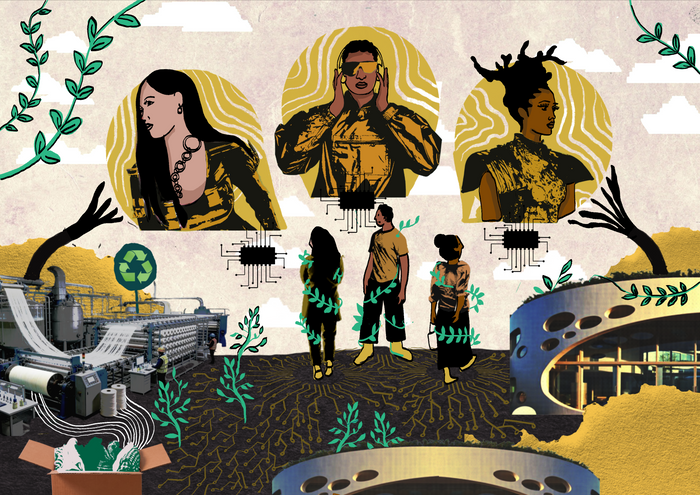
These are among four scenarios developed by Forum for the Future, with support from H&M Foundation, under the umbrella of Textile Futures 2040, which explores what the fashion industry of 2040 might be like.
And rather than pure doomsday scenarios, surprisingly not all aspects of these imagined futures are negative.

Plausible, not predictive
Clearly, Forum for the Future can’t predict the future and it isn’t claiming to. But it has worked to make the four scenarios in Textile Futures 2040 plausible by getting input from over 60 stakeholders from different parts of the fashion industry.
Each scenario dials up and down different factors, drivers and trends to create an imagined future that tests assumptions, drives conversation and gets the industry thinking. There’s no ‘preferred’ scenario because there are good and bad aspects to each, just as in current life.
These imagined futures also highlight the power the fashion industry has to help shape what comes next. Even in an imagined future that feels more pessimistic at first glance, there are opportunities for exciting and beneficial innovation.
Innovation in every future
Although each of Textile Futures 2040’s imagined futures is different, there are some common threads in how fashion might respond to them.
Circularity crops up in most of the scenarios, indicating that the fashion industry sees opportunities in this to conserve and secure resources, to meet future climate targets, and support new revenue streams around repair and reuse. Necessity may be the mother of invention but equally businesses may see competitive and financial opportunities around textile-to-textile recycling.
Durability and repairability also crops up repeatedly starting at the garment design stage. Under some scenarios, sewing and weaving skills are in demand, whether it’s to create higher-priced, artisan products, or to support regional self-sufficiency through tailoring hubs as in the Global Storms, Local Shields example.
Unsurprisingly, technology has its part to play, whether it’s driven by governments or corporations, from AI to robotics to forecast, automate and enable.
For example, in the Power Shift scenario, one imagined outcome is customers can tap a card against their clothing to find out deeper information about each item. This might be who made it and how much they were paid, where it was manufactured, where the design came from and any cultural inspiration.
Alongside this level of transparency, this card could also connect consumers with local tailors for repair and remake services, making keeping clothing in circulation longer easier.
New technological developments could even make it possible to recover materials from a wider pool of consumer and industrial waste, such as clothing made of a blend of different materials.
Textile Futures 2040 also touches on opportunities for new material developments that improve utility and reduce waste.
The New Noosphere scenario imagines a world where consumption is closely monitored and textile production volumes are capped as a result. New biomaterial developments could be compostable and even incorporate seeds, enabling items to be buried at their end of life and grow into new raw material.
Under the New Age Corporate Empire scenario, Forum for the Future also suggests that clothing could become more durable and incorporate synthetic fibres that adapt to the weather, helping keep people cool in hot temperatures and warm when it becomes colder.
Why ‘What if’ is so powerful
Some of this probably sounds farfetched; fantastical in fact. And if it helps it’s grounded by plenty of very plausible scary stuff in the full scenarios.
Certainly, it’s unlikely that things will play out exactly as outlined in Textile Futures 2040. These scenarios aren’t meant to be a blueprint and we probably wouldn’t want them to be.
But what they do so well is ask ‘What if?’ What if this was the world? What would fashion do? Or more importantly, what could it do?
This line of thinking is so interesting because rather than just highlighting the challenges, the industry gets to think about how it wants to respond.
Planning for the future is not the same as predicting it. You don’t have to know exactly what will happen to make informed decisions as a business or an industry. In fact, knowing that the future isn’t set means you have the chance to shape it. The question is, what do you want it to look like?