

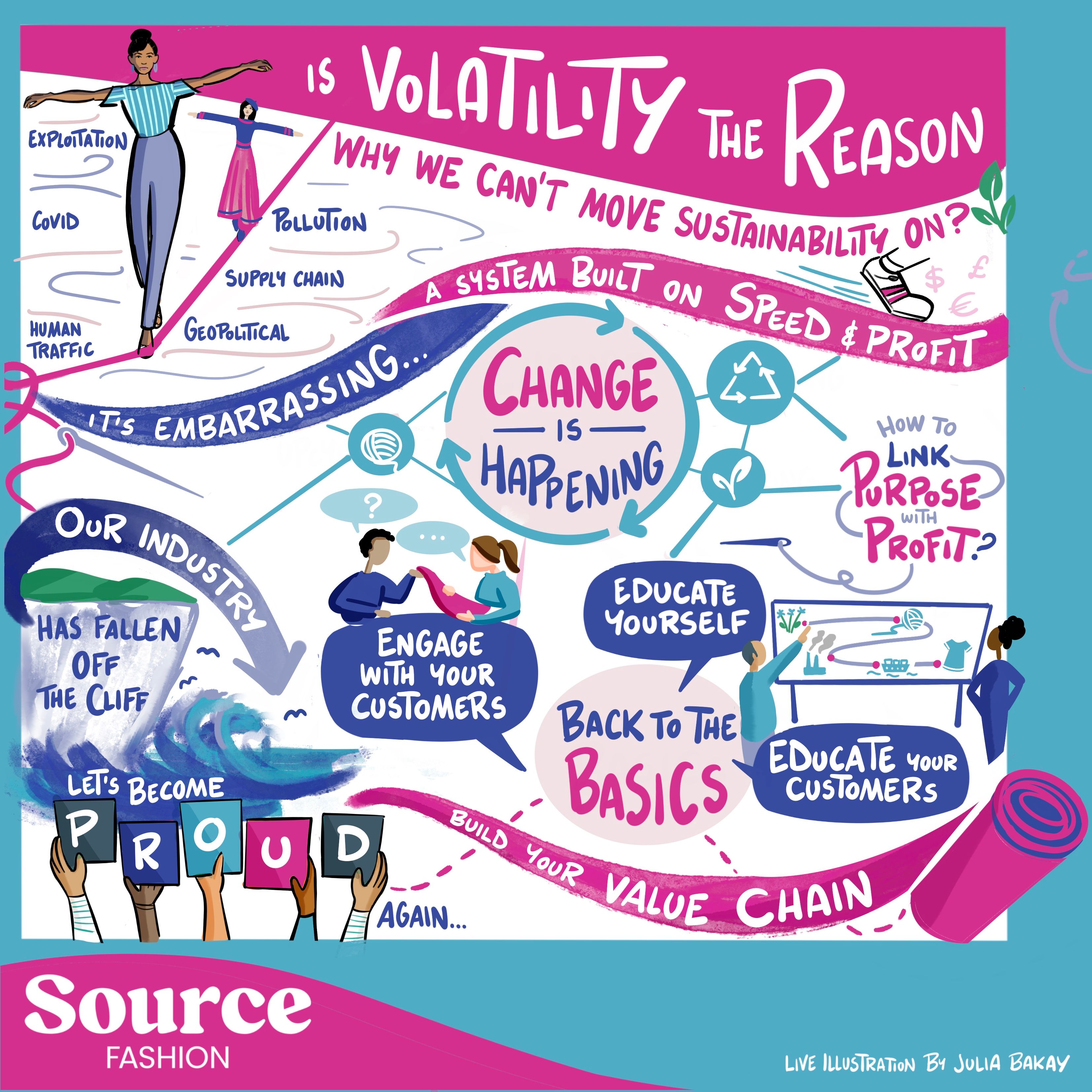
Será a volatilidade a razão pela qual não conseguimos fazer avançar a sustentabilidade?
)
We've built a fashion system addictively good at one thing: speed. Newness at any cost.
Profit measured by this quarter, not the next decade. When the world wobbles - pandemics, geopolitics, supply chain crunches, commodity spikes - our reflex is to point at 'volatility' as if it's a freak event. It isn't.
Volatility is the climate we now trade in. If a business can only behave responsibly in perfect weather, it's not a business model; it's a fair-weather hobby. So, let's stop asking whether volatility prevents sustainability and start asking a sharper question: how do we design for volatility so sustainability becomes the resilient, profitable default - not the first thing cut when margins squeal?
Julia's infographic beautifully outlines some of the themes our industry keeps circling - from 'linking purpose with profit' to a desire to go 'back to basics'.
'A system built on speed and profit' (and why it makes us brittle)
Speed isn't the villain - fragility is. We've mistaken velocity for value. The race to land the trend first led to thinner margins, brittle supply chains, and a habit of solving long-term risks with short-term hacks.
As empresas com um desempenho verdadeiramente elevado são rápidas e previsíveis.
They remove noise from design briefs, lock specs early, reduce SKU bloat, and build supplier partnerships that anticipate demand patterns. In that system, sustainability measures - like chemical controls, wastewater treatment, or living-wage-aligned costing - aren't extras; they're the rails that keep trains on time.
Como é que associamos o propósito ao lucro?
Com demasiada frequência, o propósito é tratado como um projeto secundário — algo que se faz quando os resultados financeiros são bons. Mas as verdadeiras vitórias acontecem quando o propósito está diretamente ligado aos fatores-chave do negócio.
Um menor consumo de energia nas fábricas reduz as contas. Os produtos duradouros reduzem as devoluções e aumentam a fidelidade dos clientes. Prazos de entrega razoáveis reduzem os problemas de qualidade e os custos de transporte aéreo.
Quando medimos a sustentabilidade nos mesmos termos em que medimos o lucro, deixamos de a considerar como um valor moral secundário e passamos a vê-la como um motor do sucesso a longo prazo.
This isn't about 'selling the dream' to the CFO - it's about showing them the numbers and proving that the most responsible choice can also be the most financially sensible one.
De volta ao essencial
When we talk about 'going back to basics' in sustainability, it can't mean scaling back ambition.
Significa concentrar-se nos aspetos fundamentais que realmente fazem a diferença: conceber produtos com vista à durabilidade, escolher materiais com benefícios mensuráveis em termos de impacto, garantir condições de trabalho justas e ter a logística sob controlo.
These aren't glamorous steps.
They don't generate headlines or award entries. But they are the foundation of any serious sustainability strategy. Without them, everything else is just window dressing.
'It's embarrassing' - good!'
O embaraço é útil.
It's the gap between the brand we claim to be and the brand we are. Maybe we need to sit with that... and then try and fix that gap.' There's something quietly powerful about the admission that parts of our industry's behaviour are embarrassing. Greenwashed marketing, vague impact claims, overpromised targets - it's all starting to wear thin with consumers, regulators, and even employees.
Embarrassment is a sign that our public narrative and our internal reality are out of sync. But embarrassment can be catalytic. It's the sharp jolt that says, 'We have to do better, and we have to show it.' Not through lofty slogans, but through receipts - proof that our products are made responsibly, that we stand behind their quality, that we're willing to repair or replace when they fail.
Pride in our industry won't come from looking perfect. It'll come from closing the gap between promise and practice.
A mudança está a acontecer

It's easy to think progress is glacial, but underneath the noise, change is real.
As fábricas estão a investir em processos mais ecológicos. As marcas estão a analisar as cadeias de abastecimento de forma mais aprofundada do que nunca.
Retailers are trialling resale, rental, and repair models that were fringe ideas only a few years ago. It's happening in pockets, sometimes quietly, often without fanfare. The question is whether these changes are embedded in the DNA of how we do business, or if they're pet projects that can be paused when budgets tighten. Sustainability has to live in every department - design, sourcing, logistics, marketing, finance. If it's seen as 'the sustainability team's job,' it will never scale.
The most successful brands will be the ones where sustainability is invisible because it's just how things are done.
Let's become proud again
Pride won't come from perfect press releases.
It will come from a garment you can point to and say: 'We made this well. We made this fairly. And if anything goes wrong, we'll make it right.' It will come from suppliers who volunteer to join your next project because working with you makes their business stronger. It will come from customers who keep wearing your product - and talking about it - long after the campaign ended.
'Our industry has fallen off the cliff,' the illustration suggests. Maybe that fall cleared the view. We can climb again, and the route is steep but clear: fewer claims, more proof; fewer vendors, deeper ties; fewer SKUs, better product. Volatility isn't the reason we can't move sustainability on. It's the reason we must.
Bottom line: Pride isn't perfection - it's accountable progress, visible in the product and felt in the wear.
Quer ver os debates ao vivo? Inscreva-se aqui para o Source Fashion, em janeiro de 2026!